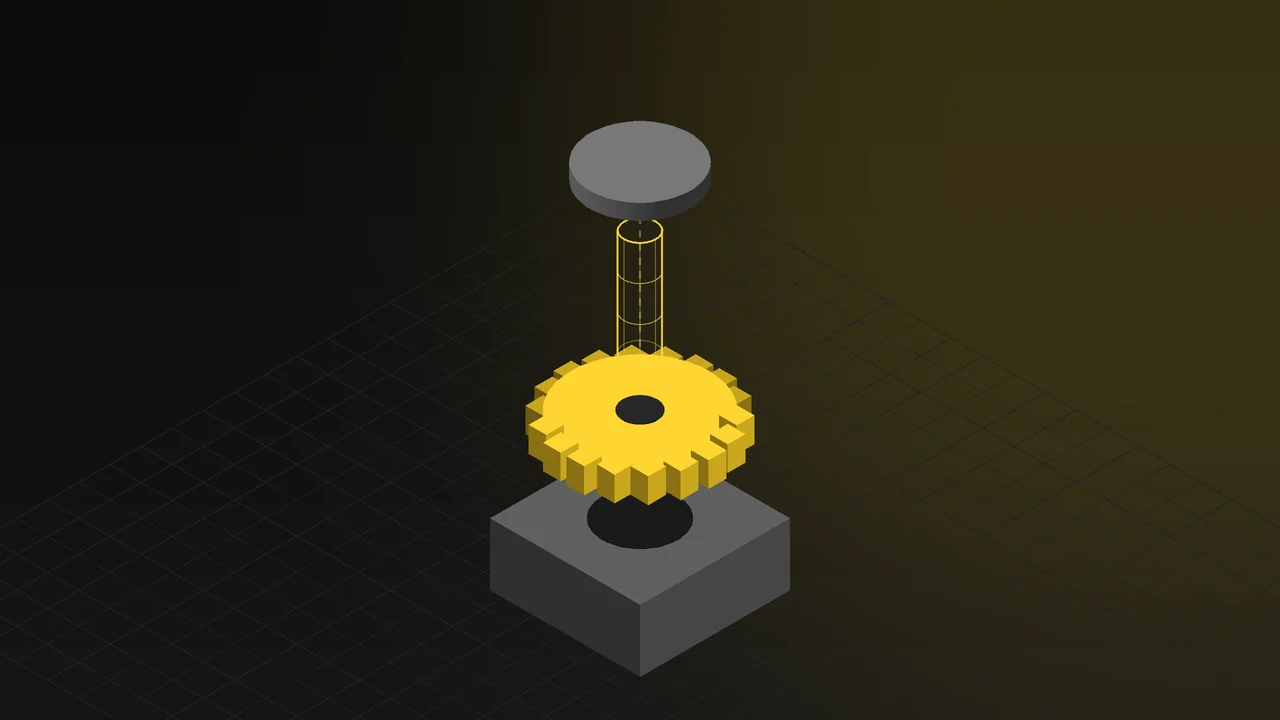
Showing what is inside a machine, how an axle is assembled or how a production line works is often impossible with photos or a traditional video shoot. The parts stay hidden inside the housing, the product is very large, or it is still a prototype. This is exactly where industrial animation comes in.
In this article we explain what industrial animation is, which types serve which purpose, its advantages over filming, and what to prepare for a project.
What is industrial animation?
Industrial animation explains machines, equipment, spare parts, systems and production processes in motion using 3D models. The goal is to show a product's technical advantages and how it works so clearly that even a non-technical viewer understands at first glance. For a general introduction, see our article what is 3D animation and how is it made?
Types of industrial animation
| Type | What it explains |
|---|---|
| Product promotion animation | The product's key features and why it should be chosen; for the website, ads and launches. |
| Working principle and mechanism | How the parts work together and how motion and power are transferred. |
| Cutaway and exploded views | The structure inside the housing, by separating the parts or cutting the product open. |
| Assembly, installation and maintenance | The assembly sequence, installation and maintenance step by step; for training and service teams. |
| Production process and facility | The stages from raw material to finished product, or how a facility operates. |
| Trade show and sales presentation | Videos that run on the stand screen or open in a sales meeting, showing the product without carrying it. |
Why 3D instead of filming?
- It shows what cannot be seen: A camera cannot go inside the housing; a 3D camera can move between gears, through fluids and right up to where parts meet.
- It works before the product exists: A product that has not been manufactured yet can be modelled from design files and promoted before launch.
- It makes large, heavy products easy: Preparing, lighting and filming a construction machine, a truck or a production line from the right angle is hard; in 3D there is no limit to scale.
- It simplifies complex information: Unneeded details are hidden and important parts are highlighted with colour and light.
- It is easy to update: When the product changes, the relevant part is updated in the model and the scenes are rendered again; there is no need to reshoot.
- It can be adapted to other languages: Versions for different markets can be produced by changing the text and voice-over without touching the footage.
Example: fully assembled driven rear axles
This animation, made for Güriş Industrial Group, explains fully assembled driven rear axles produced by combining material, forging, casting and machining engineering. The axle's internal structure and parts are shown from angles that would be impossible on a real product.
Example: heavy truck product portfolio
In this work, the same group's heavy truck product portfolio is brought together in a single video, presenting different products in a shared visual language. Portfolio videos like this are used at trade shows and in corporate presentations to explain a brand's product range quickly.
Which industries use it?
Industrial animation is used in every industry whose products are technical and that needs to explain that technology to its customers: automotive and suppliers, machinery and construction equipment, agricultural machinery, energy equipment, hydraulic and pneumatic systems, electrical devices, building products and medical devices are among the most common.
How is an industrial animation made?
- Brief and goal: The product, target audience, where the video will be used and the main message are defined.
- Script and storyboard: The flow of the video is planned scene by scene and presented for approval.
- 3D modeling: The product is modelled from CAD files, or from photos and measurements. See our article on 3D product modeling for details.
- Animation, lighting and rendering: Scenes are built with camera moves, materials and lighting, then rendered.
- Editing and delivery: The video is completed with music, text and graphics, and delivered in the formats needed for the web, trade show screens and social media.
You can find every step of the process and example projects on our 3D product animation page.
What should you prepare for a project?
- Technical files: CAD files or technical drawings if available; otherwise product photos and measurements.
- Features to explain: What sets the product apart from competitors and must be visible in the video.
- Where it will be used: Trade show, website, sales presentation, training or social media; length and aspect ratios are set accordingly.
- References: Animation examples you like, plus your corporate colours, logo and fonts.
Frequently Asked Questions
Is there a difference between industrial animation and product animation?
They largely describe the same work. Industrial animation is a general name for 3D animations that focus on technical subjects such as machines, equipment and production processes. Product animation focuses on promoting a single product.
Can a complex machine be explained to a non-technical audience?
Yes. With cutaways, exploded views, colour highlights and short captions, even the most complex mechanism can be explained step by step and clearly.
What determines the price of an industrial animation?
It depends on the complexity of the product, the length of the video, the number of scenes and the render quality. See our article on 3D animation pricing for details.
Can product images be taken from the animation?
Yes. High-resolution images for catalogues, the web and presentations can also be produced from the models and scenes prepared for the animation.
Tell us briefly about your product or process, and we will work out the right industrial animation plan together. Take a look at our 3D product animation service or get in touch.