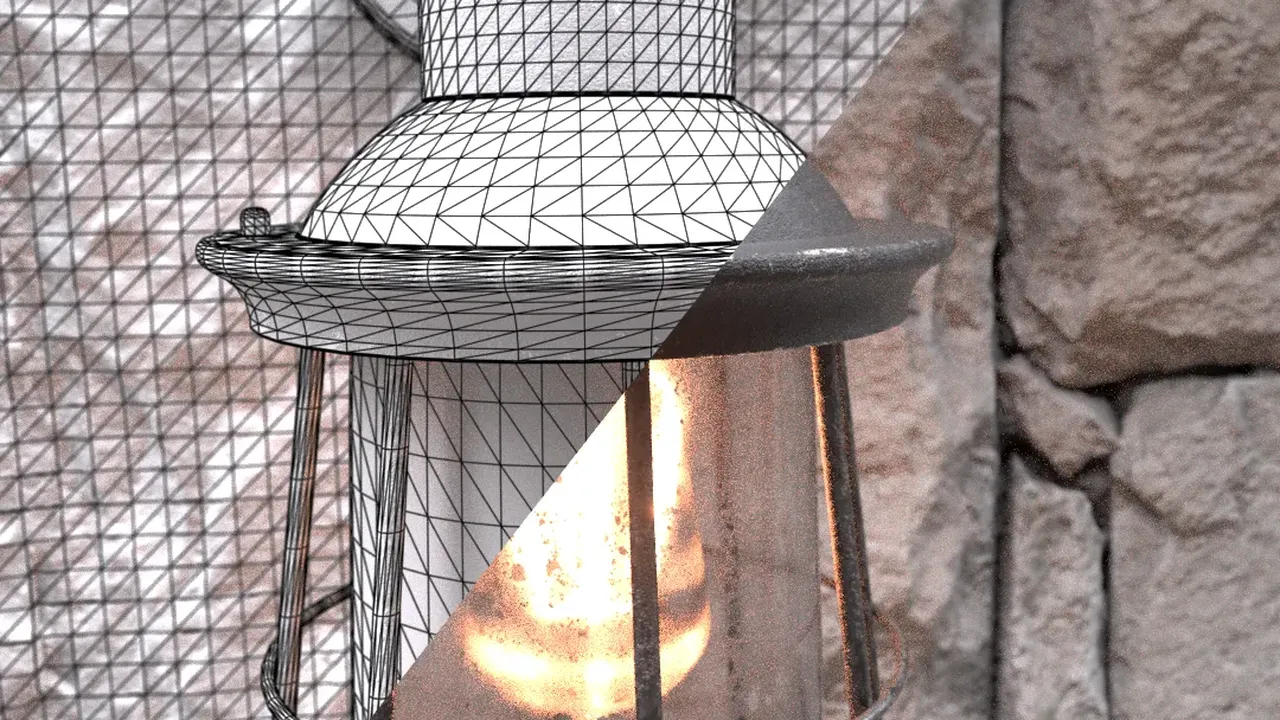
What Is 3D Rendering?
I'd like to repeat the definition of 3D rendering using the analogy from my earlier post, “Technical Factors That Affect 3D Animation Pricing”. 3D rendering is to the 3D visualization process what baking is to making a cake. Once the cake is baked, its smell, look and taste take on the form they are meant to have. The preparation and baking stages cannot be separated. In other words, you can't get a good cake by baking a bad batter perfectly, or by baking a good batter badly. Nor can you expect a raisin cake to smell like a chocolate cake.
What Is Photorealism?
Photorealism is an art movement in painting that aims to reproduce the realism of photographs exactly. Think of a photograph taken with a camera. Then imagine someone saying, “I can paint exactly the same thing in oils,” and reproducing it down to every detail. The resulting painting is a photorealistic painting. The key point here is that the reference is not real life, but the photographic frame.
Just as in painting, photorealistic 3D renders differ from ordinary renders in that they imitate photographic realism. The entire process, from 3D modeling to render settings, plays a role in photorealistic 3D visualization.
Requirements for Photorealistic 3D Product Visualization
Realistic 3D Modeling
Deformation Based on Material Structure
All modeling done for manufacturing purposes in industry aims for perfection. That is a disadvantage for photorealism. For example, a large, thin sheet-metal panel covering the surface of a huge machine looks as rigid as marble in the 3D model, but in real life the surface has barely visible undulations caused by the flexibility of the material. When light hits it, these undulations become noticeable. The form of a surface tells you something about the material, independent of its finish.
Considering that models for industrial 3D visualization are usually flawless models supplied by the manufacturer, minimal deformations suited to the material structure should be applied to them where needed.
Detailed Modeling
When modeling a machine, parts that are not manufactured in-house (screws, nuts, bearings, switches, servo motors, control panels, etc.) are usually not drawn from scratch; ready-made CAD models or BIM objects are used. However, the level of detail (LOD – Level of Detail) of these models can be low. In that case, the detail level of low-detail models should be increased, or they should be replaced with high-detail models.
In addition, materials that will go through different manufacturing processes may not be modeled with the details of the product's final form. For example, in a drawing of a wooden dining table, all edges and corners may be modeled at a knife-sharp 90 degrees. In production, however, the edges are softened by processes such as chamfering. That's why adding detail to models is important for photorealism.
Materials and Finishes
At the heart of photorealistic 3D product visualization lies the imitation of photography. A photographer doesn't change how the material of the product being shot physically responds to light; they arrange the setting and the lighting to get the most accurate result. Materials such as glass, chrome, glossy plastic and matte plastic respond differently. In 3D visualization, on the other hand, the content creator defines the physical responses of materials to light numerically.
While a photographer uses tools such as diffusers, softboxes and reflectors to soften the reflections on a highly reflective material like chrome, a 3D visualizer can intervene directly in the material. But this is the wrong approach, and it can produce unexpected results under different lighting scenarios. That's why knowledge of materials (reflectivity, roughness, metalness, transparency, emission, index of refraction, etc.) contributes greatly to photorealism.
Imperfection
Imperfections are indispensable for photorealism. Especially on surface finishes, dirt, oxidation, fingerprints, dust residue, brush or tool marks from production, paint defects, and wear marks from impact and friction are important details.
For photorealistic 3D product visualization, it is very important to know these imperfections and details of the manufacturing process well. In industrial 3D visualization projects, drawing on the know-how of engineering and R&D teams and of the skilled workers on the shop floor is extremely valuable.
Lighting Design and Settings
Since I'm writing for clients, I won't go too deep into this technical subject. Put simply: no light, no visualization. 🙂 Light affects not only photorealism but also image quality, render time and the emotion the image conveys.
Camera Settings
As I pointed out at the beginning of this post, “The reference here is not real life, but the photographic frame.”
There are important differences between looking at an object with the naked eye and looking at a photograph of that object. A photograph interprets reality according to technical characteristics such as the lens's focal length, aperture, sensor response and light sensitivity. Depth of field, lens distortion, chromatic aberration and lens flares are characteristics we can't see with the naked eye but that are present in photographs.
Photorealistic 3D product visualization aims to reproduce not reality itself, but its ‘photographed’ form as we perceive it visually.
Workflow and Post-Production
An ordinary render always looks more artificial than an ordinary photograph. That's because a camera captures light, contrast and depth the way we're used to seeing them. In a render, this effect doesn't happen on its own. In terms of the data it stores, an ordinary 3D render is far more limited than an ordinary photograph. But when 3D visualization follows the right workflow, these limits can be overcome, and it can even go beyond what a camera can do.
In a 3D visualization process that has followed the right workflow, post-production is also far more effective.
Does Photorealism Matter in 3D Visualization?
I don't think there's any need for fancy words on this subject.
If it bothers you that a machine you developed through long effort, invested R&D in, are proud to have been part of producing, and offer on the strength of its robustness, durability and performance looks like Lego in your marketing, or that a render of a toy construction machine on TEMU looks more realistic than the render of your real construction machine, then photorealism matters in industry.