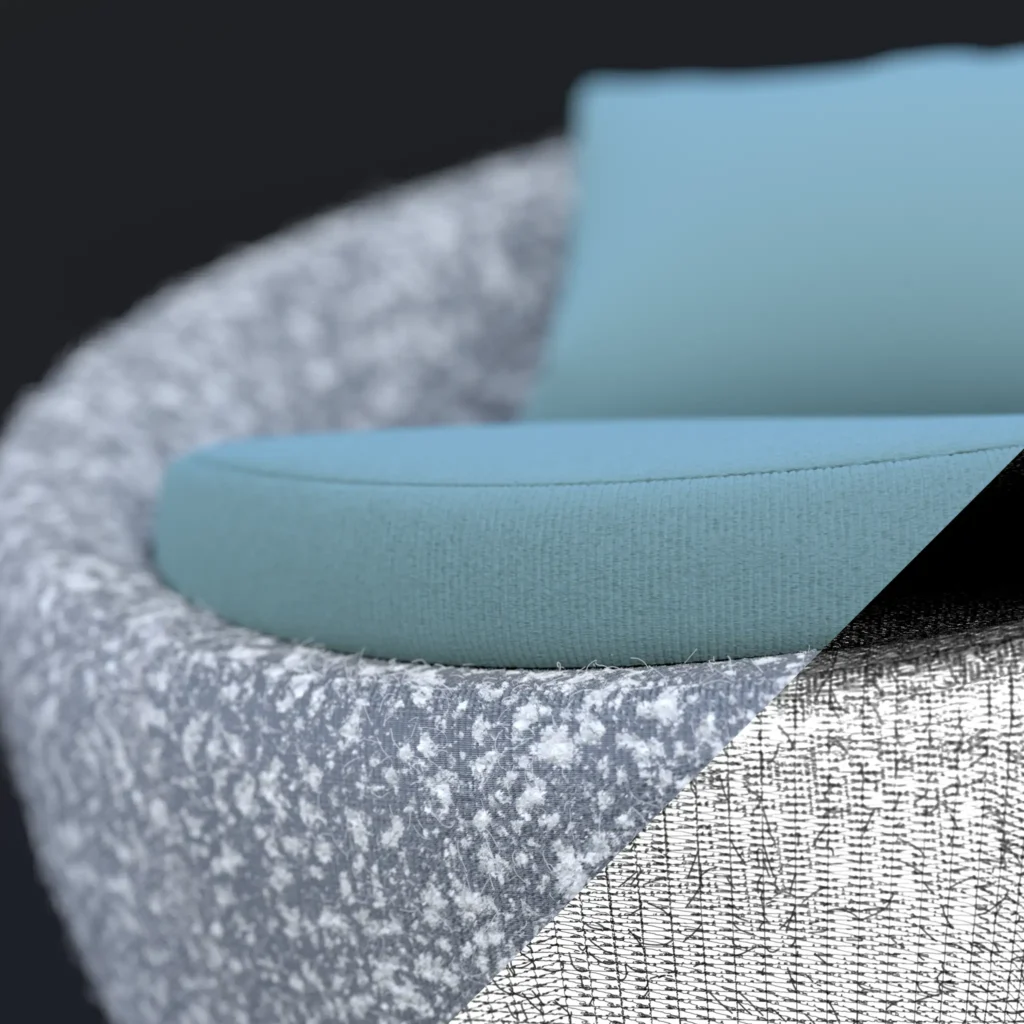
3D visualization requests from the furniture industry tend to share a number of common problems, especially when it comes to fabric upholstery. These problems affect not only visual quality but also time management and costs directly.
Common Problems with 3D Fabric Upholstery
- Structural patterns on the fabric repeating themselves like floor tiles
- Texture dimensions that do not match reality
- Low-quality, artificial-looking results in close-up renders
- Specialty textured fabrics such as teddy or bouclé not looking like the real thing
- Time-consuming material creation and update processes
- When working with different service providers, having to go through the whole process again and again, and inconsistent results.
Because furniture manufacturers do not produce their fabrics themselves but source them externally, they do not have technical or visual data such as the pattern, texture or yarn type. This is the root cause of the problems listed above in the 3D visualization process.
First, let's decide on the name of the service that will solve this problem.
Is it 3D rendering, 3D visualization or architectural rendering?
Then, who should we get the service we need from?
Wouldn't architectural visualization firms solve our problem?
Couldn't our advertising agency do this job?
Or would it be best to ask that person who always finds someone to do the job in a snap whenever we need something?
The name of the service you need is “Consulting”. Rendering and visualization are only one part of this process. The service you need is not, and should not be, simply covering a 3D object with fabric and rendering it.
In other words, rather than producing 3D render images, the goal should be to build a parametric and sustainable digital material library for your products. This is exactly where consulting is needed.
Why Consulting?
A 3D visualization consulting service anticipates your company's long-term needs and keeps you from running into the same problems over and over again.
What Does Consulting Give You?
- A parametric and sustainable digital material library is created.
- Rendering processes get shorter, and the need for revisions decreases.
- Time and budget are not spent again and again.
- Your upholstery stays consistent even if you work with different service providers.
Moreover, if this system is delivered in universal formats, you end up with a platform-independent setup. That way, in projects such as:
- Catalog renders
- Interactive web applications
- Mobile configurators and AR/VR projects
- 3D product animations
all values, including fabric texture, scale, reflection and direction, will match perfectly, even if you have worked with different service providers at different times.
To see more of our web application work, visit app.mehmettorni.com.
Are Architectural Visualization Firms the Right Choice?
Generally, no. Architectural visualization firms, especially those serving the construction industry, work from ready-made material libraries. These libraries certainly offer high-quality materials, but they will not contain an exact match for the unique fabric used on your product.
In other words, just as you, as a furniture manufacturer, buy fabric ready-made and upholster your sofas and beds with it, that visualization firm will most likely take a ready-made material and apply it to your product in the same way. This is perfectly natural. However, since the chances of finding an exact match for your fabric in existing libraries, and of keeping that match consistent over time, are very low, this approach is not the right option for you.
Is Photographing the Fabric to Create a Material the Solution?
So what if the 3D visualization firm took our fabrics, photographed them in high resolution as x cm by x cm squares, and built the material from those photos?
It sounds good, but many problems will come up at the very first step:
- If the lighting does not fall evenly across the fabric, the shadows at the edges will repeat and create unwanted shadow patterns.
- When the photo is laid out like tiles, lines will appear at the seams.
- Natural features of the photographed area, such as wrinkles and various imperfections, will repeat constantly, which will also create a repeating pattern look.
The good news: Many of the problems on this list can be solved. There are even AI tools for this work now.
There are also expensive, impressive devices built specifically for the textile industry that photograph the fabric and help you solve these problems with their built-in software.
But even if all of these problems are solved, I can't say this is the best approach.
Especially for fabrics such as heathered, tufted or bouclé fabrics.
Let me try to explain why with a hypothetical example:
Imagine a 4×4 square. Let this square represent the photo of the fabric.
- Let's assume we photograph the fabric very closely and fit 10 threads by 10 threads into this 4×4 area.
- This close-up shot makes the details look good in close-up renders.
- But to cover the sofa, you have to use the resulting material at a very small scale with a lot of repetition.
- Even if you join the seams of this repetition flawlessly, the area in the middle of the 4×4 square will keep repeating itself, so a tile-by-tile repetition effect will be clearly visible.
- This close-up shot makes the details look good in close-up renders.
- So what if we take the photo from further away? Say, so that 10,000 threads by 10,000 threads fit into the 4×4 area…
- Great idea! From a distance, no repetition will be visible, because the number of threads you captured is enough to cover the entire product shown on screen.
- But what if we want to show this product in a close-up?
- That means zooming into the 4×4 photo.
- Just as a photo you take with your phone breaks up and loses detail when you enlarge it a lot, your product will look ugly in close-up renders.
- That means zooming into the 4×4 photo.
- Great idea! From a distance, no repetition will be visible, because the number of threads you captured is enough to cover the entire product shown on screen.
- Here's one more idea:
- Let's take 4 different 4×4 photos and combine them into a single, much larger and more detailed 8×8 photo.
- If you place this photo in the image the same way, you will have improved the product's close-up detail by a factor of 2.
- But from a distance, the thread details may look much denser than normal. This causes the texture to get lost.
- And if this is not a plain fabric but a design with a pattern on it, the pattern will look much smaller than it should and repeat far more often.
- Also, if you use such a high-resolution file for just one fabric, you may run into technical problems in render scenes made up of several products.
- Let's take 4 different 4×4 photos and combine them into a single, much larger and more detailed 8×8 photo.
The Right Solution: Using Procedural Materials
The Procedural Concept and Its Advantages in 3D Visualization
In 3D visualization, the concept of “procedural” is used not only for materials but also in other processes such as modeling. At its core, the concept means this: with a procedurally generated structure (for us, this is a material), you can intervene all the way down to its smallest building block. But to benefit from this flexibility, you have to start from the smallest detail when creating your material.
So if you want to create a fabric, you should first create a digital replica of the yarn, then weave the fabric from these yarns. After that, you add the weave structure, the pattern or the print to the fabric surface. Just like in the physical production process… This way, you not only get flawless surfaces but can also make quick updates to elements such as pattern, color and yarn spacing.
This method is a parametric structure. For people who work with visuals, the difference between a photo and a vector image is a good analogy: just as a vector is resolution-independent and flexible, a procedural material works on the same principle.
To better understand the procedural concept, let's build an iron chain procedurally in our minds together.
First, I'll focus on a single link of the chain.
Imagine a rectangle

Let's give this rectangle a width and height similar to those of a chain link.

Then let's round the corners of this rectangle.

Let's give our chain link some thickness

Let's duplicate this link side by side as many times as we want

Let's rotate each successive link by 90 degrees

Along the way, we have defined all the data needed to create a chain parametrically. Because of this, we can quickly update any value we want, from the first step to the last.
For example, by updating the relevant settings to get a much thicker chain
we can get a chain like the one below.

If we had started by creating the material from photographs, we would have had a photo of an existing chain, and we could not have changed many of its properties afterwards, such as the thickness, width or length of its links. If needed, we would have had to find a chain with thicker links, repeat the whole photo shoot from scratch, and end up with a result containing various imperfections.
By creating a procedural material, however, we were able to build a brand-new chain by adjusting just a few parameters. And the chain we created works like a vector image. You can look at it as closely as you like. There is no degradation. With this method, you can even add micro details, such as the fibers sticking out of a single thread. For example, scratches or oxidation on the chain, and so on… All of these details can be added without repetition, or, if the chain links turning at a perfect 90 degrees looks unrealistic, you can add a random 2-degree deviation.
It is not the topic of this article, but applying the material correctly to your 3D model is also very important. When the procedural material is applied correctly, you can build a standardized library for your company. With this library, you get results of the same quality even when you work with different service providers. This library gives you the freedom to work with any 3D rendering provider you choose.
This brings us back to the scenario at the beginning. You can also work with a provider that uses ready-made materials, because now you have your own materials too. And these materials will match your products perfectly, even across different 3D software and render engines. They will even let you keep the same standard in other areas, such as interactive 3D applications and web software.
Conclusion: The Future for Furniture Brands Is Procedural
Competition in the furniture industry is now shaped not only by manufacturing quality but also by the quality of digital representation. If you want to stand out with realistic, non-repeating, optimized fabric upholstery, you should definitely consider the procedural material approach.
You should think of this process not as a render order, but as an investment in building a digital fabric infrastructure unique to your brand.
Follow our social media accounts to keep up with the technical processes behind our projects, take a closer look at our latest 3D animation work and get in touch with us.
YouTube LinkedIn Instagram